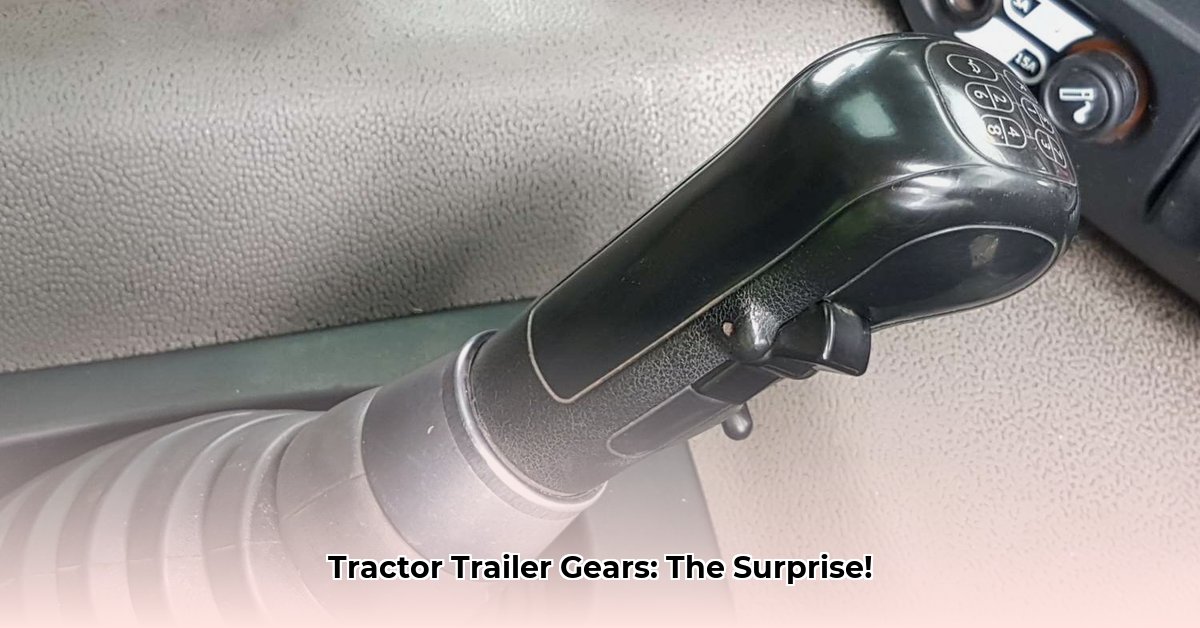
Ever wondered how many gears a semi-truck boasts? The answer isn't a simple number; it's a range, typically between 10 and 18 gears. This variability stems from several factors, including the manufacturer, the specific truck model, and the type of transmission system employed. For more on truck dimensions, check out the average tractor-trailer length. Understanding these nuances is key to grasping the intricacies of these powerful machines.
Factors Influencing Gear Count: Manufacturer, Model, and Transmission Type
The number of gears in a semi-truck isn't arbitrary. Manufacturers meticulously select the optimal gear count based on the intended use of the vehicle and the type of transmission. A truck designed for heavy hauling and mountainous terrain will require more gears than one intended for flat highway driving. More gears provide finer control, crucial for navigating challenging conditions. This is especially important when considering the significant weight differences between an empty truck and one at maximum capacity. Do you think an empty truck needs the same number of gears as a fully loaded one?
Types of Transmissions: Manual, Automated Manual, and Automatic
Three primary transmission types power semi-trucks: manual, automated manual (AMT), and automatic. Each offers a unique blend of control, efficiency, and driver experience.
1. Manual Transmissions: These traditional transmissions require the driver to manually shift gears, providing maximum control and potentially optimal fuel efficiency when operated by a skilled driver. However, this demands considerable skill and physical effort, leading to driver fatigue on long hauls.
2. Automated Manual Transmissions (AMTs): AMTs automate the clutch and shifting process, reducing driver effort while retaining a degree of manual control. Drivers can override the automated system when necessary, offering a balance between convenience and precision.
3. Automatic Transmissions: These fully automatic transmissions relieve the driver of all gear-shifting responsibilities, resulting in a smoother, less fatiguing driving experience. However, automatic transmissions may slightly compromise fuel efficiency compared to expertly driven manuals or AMTs.
| Feature | Manual Transmission | Automated Manual Transmission (AMT) | Automatic Transmission |
|---|---|---|---|
| Gear Selection | Manual, Driver controlled | Automated, with driver override option | Fully automatic |
| Driver Skill Level | High skill and significant experience required | Moderate skill; training recommended | Minimal skill required |
| Fuel Efficiency | Potentially best with an expert driver | Generally good | Generally good, but may vary depending on driving |
| Maintenance | Higher; clutch wear and other components | Moderate | Lower |
| Driver Fatigue Level | High; can lead to significant fatigue | Lower; reduces driver fatigue | Very low; minimizes driver fatigue |
Gear Ratios & Their Function: Optimizing Power and Speed
Gear ratios define the relationship between the engine's speed and the wheels' speed. Lower gears provide more torque (power) – ideal for starting, hauling heavy loads, or climbing hills. Higher gears prioritize speed and fuel efficiency, perfect for highway driving. The precise selection of gear ratios is a critical aspect of truck design and directly impacts the overall performance and efficiency. Given the vast power demands of large trucking operations, how crucial is the correct gear ratio selection to the bottom line?
Fuel Efficiency & Gear Selection: The Impact on Economy and Engine Life
Proper gear selection is paramount for fuel efficiency and engine longevity. "Lugging" the engine (forcing it to work too hard in too high a gear) or "over-revving" (keeping the engine at excessively high RPMs) wastes fuel and prematurely wears engine components. Finding the optimal gear for each situation is key for economical and sustainable operation.
Gear Shifting Techniques (Brief Overview): Double-Clutching and More
While a full driving manual is beyond this article's scope, understanding some basic techniques is valuable. Double-clutching, primarily used in older manual transmissions, involves briefly depressing the clutch twice during a downshift to synchronize engine and transmission speeds. AMTs and automatics automate this process. However, understanding the fundamental principles behind smooth gear changes remains paramount, regardless of the transmission type.
Safety and Gear Selection: Preventing Accidents like Jackknifing
Gear selection significantly impacts safety. Improper gear choices, especially on descents, can lead to jackknifing – where the trailer swings out, creating a dangerous situation. Utilizing engine braking (downshifting) before curves or stops significantly reduces this risk, particularly in challenging conditions. The effective use of engine braking is crucial for safely navigating downhill passes.
Conclusion: Mastering the Gears for Efficiency and Safety
The number of gears in a tractor-trailer is more than just a number; it reflects the complex interplay of design, intended use, and technological advancements in transmission systems. Understanding the various aspects of gear selection—from transmission types and gear ratios to fuel efficiency and safety—is crucial for the efficient and safe operation of these essential vehicles. With the right understanding, one can transform the simple act of gear shifting into a powerful tool for efficient and safe trucking operation.